
INDIAN LABEL TIPS MUSIC INKS GLOBAL LICENSING DEAL WITH FACEBOOK

This article was published on: 28th December 2021 Article Link: https://www.musicbusinessworldwide.com/indian-label-tips-music-which-attracts-over-5bn-youtube-views-per-month-inks-global-licensing-deal-with-facebook/
Vision 2025-The Show Must Go On

Download the full report here
Royalties in Private Radio Industry of India

“Royalties in Private Radio Industry of India”- is written by Dr. Darshan Ashwin Trivedi, Adjunct Faculty – MICA. The paper makes a case for royalty negotiations to take place between radio broadcasters and music companies to decide fair value of royalty under free market practices. It also lays out why compulsory licensing regime is not recommended. Download the full report here
GIVING THE MUSIC INDUSTRY ITS DUE: ANTIQUATED REGULATIONS ARE DAMMING MUSIC REVENUES

The following OPED was published on 17th September 2020 in the Financial Express. The WIPO creative industry study is a globally-accepted document designed to calculate the value of the contribution of the creative sector to the economy. Big Hit Entertainment, a South Korean music label, will launch its IPO in October 2020 with a $4 billion valuation. Home to the K-pop band BTS, the label plans to hand each member of the band a special onetime reward of shares worth $8 million. It’s a classic example that illustrates that if the river is not dammed, the tributaries will receive more than ample supply of water. Tencent Music, listed on the New York Stock Exchange (NYSE), was valued at $26 billion as on Friday, September 11, 2020. Will India ever witness the day when its music companies see these types of valuations? What is it that ails us? Does the current regulatory framework help in unlocking fair value and addressing the value gap? According to the International Federation of the Phonographic Industry’s Global Music Report, while Brazil earns $313 million from the recorded music industry, India earns just $181 million. While there are a lot of similarities between the two markets, there is one stark difference; Brazil is more or less homogeneous in culture and has one predominant language—Portuguese—whereas India has diversity in culture and language. The Indian heterogeneity mirrors Europe, which is the perfect ecosystem for the creative industry. If that is the case, why is Brazil ahead of India in the recorded music business? Post the 2012 amendments to the Copyright Act, 1957, why has the government of India not conducted a study in collaboration with the World Intellectual Property Organisation (WIPO)? The WIPO creative industry study is a globally-accepted document designed to calculate the value of the contribution of the creative sector to the economy. Recorded music may be the smallest component of the media and entertainment ecosystem, but it provides huge levels of employment and the fuel that powers the radio, film and television industries. The WIPO India study may just be the awakening needed for the neglected music ecosystem. Radio, an industry worth Rs 3,100 crore, pays just Rs 75 crore as music royalties to labels. TV spends around 20% of its revenue on developing content and bears the risk of the content being unsuccessful. Radio bears no such risks and can cherry-pick the most popular songs. The royalty pool for music labels ought to be at least `300 crore, or 10% of the top line revenue earned by the radio industry. But the government still utilises precedents and laws created when radio was a nascent industry to define royalty payable now. The regulator should take into consideration that fair value needs to be paid to the record labels by radio broadcasters. India, in its framing of the Information Technology Act, 2000, broadly followed the US’s Digital Millennium Copyright Act, 1998 (DMCA). At that time, the country needed a fertile ecosystem to encourage innovation. Circa 2020, have the safe harbour provisions benefited India’s creative industry or global tech giants based in and paying taxes abroad? Recent trends show video social media apps emerging from Russia and China taking shelter under safe harbour provisions. A relook at the intermediary liability regime under the IT Act, 2000, and associated rules is needed immediately. Public performance is another growth driver of the recorded music industry worldwide. Brazil earns $70 million via public performances, as against India’s $18 million. The wedding industry in India has an estimated value of $45 billion. But while music labels are deprived of public performance royalties during western-style celebrations at Indian weddings, the government imposes a 3% GST on even the most sacred mangalsutra. A formal recognition of a collection society for sound recordings by the government would be an excellent first move to allow creators of music to achieve fair value rewards for the risks they take and the work they do. We are all proud that, by 2025, India aims to be a $5 trillion economy, bigger than Germany, Japan, the UK and Australia. The contribution of the creative sector to the GDP in most developed markets is 4% on average; in India, it is just under 1%. Antiquated laws, relics of the past, are speed breakers slowing down India’s answer to BTS Korea. Read the same here: https://www.financialexpress.com/opinion/giving-the-music-industry-its-due-antiquated-regulations-are-damming-music-revenues/2085049/
Economic Value Of Music For Fm Radio In India
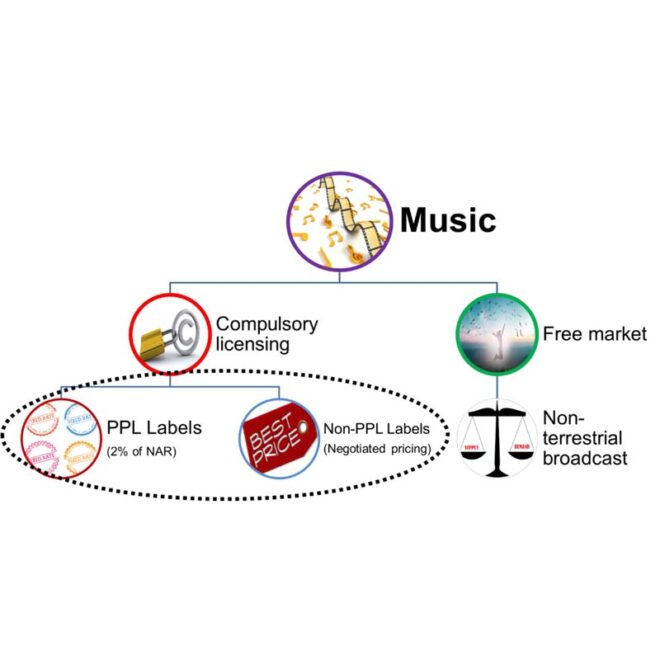
“Economic value of music for FM radio in India”- is written by Praveen Chakravarty, Scholar , Columnist, Chairman of the Data Analytics department of the Indian National Congress. The paper recommends a royalty rate of at least 7.5% royalty of gross revenues of radio companies to be paid for music. Download the full report here
IMI expects 10% of radio players’ gross ad revenue as new base of royalty for music labels.

this article was published on: 14th September 2020 Article Link: https://www.exchange4media.com/media-radio-news/imi-expects-10-of-radio-players-net-ad-revenue-as-new-base-of-royalty-for-music-labels-107573.html
A New Dawn : New Horizons & New Hopes For The Recorded Music Industry
Read the full press release here.
DISCORDANT POLICIES FOR RECORDED MUSIC INDUSTRY

The following OPED was published on 28th August 2020 in the Hindu Business Line. Shackles on the recorded music industry will impair its capacity to fund films, for which it acts as a sort of venture capitalist The Indian recorded music market is special in many respects. But the market, unfortunately, has to operate under the spectre of price controls in some areas of its business, and there’s the threat of such controls extending to newer areas. The Government should refrain from imposing price control if the Indian music industry is to be an Atmanirbhar Bharat story. Instead, it must review the existing unfair provisions that restrict the growth and development of the industry, and undermines India’s ability to leverage music’s significant soft power potential overseas. Like every enterprise, the recorded music industry creates economic value to all those connected in the value chain; artists, writers, composers, lyricists, musicians. Recorded music creates economic value and employment in sectors ranging from television, radio, digital distribution, social media, cinema, and live entertainment. Moreover, the soft power component of the industry has a significant value which is hard to quantify. The industry also supports the livelihoods of millions — from brass band-wallas and folk musicians to DJs, makers of musical instruments and hardware manufacturers. No original soundtracks, no jobs for these people. At a pan-India level, the recorded music industry is always the first outside investor in the Indian film industry, which produces close to 1,000 films annually. One of the first set of rights amortised by the movie producer is ‘music rights’. The record labels play the role of seed investor or venture capitalist when they acquire music rights before the movie starts production. Music rights As per various independent industry reports, payments made to film producers by the recorded music industry meets 12-18 per cent of the production costs of the ₹10,000 crore movie industry. An important source of revenue comes from the licensing of music rights — aka original soundtracks or OSTs. The licensing terms and conditions are always based on market dynamics. According to IFPI (International Federation of the Phonographic Industry), 70 per cent of music content consumed across India is from OSTs. The remaining 30 per cent is non-film music, where again market conditions determine the cost of the soundtrack or album. Acquisition costs of film soundtracks have seen increases ranging from 100 to 500 per cent across India. These increases are due to a functioning marketplace and the increasing demand for music entertainment. When there is a functioning marketplace in the “upstream market” of acquisition of music content, it follows that the market should also be allowed to work freely in the “downstream” market of licensing recorded music to different sales and distribution channels — including commercial radio. If the government pursues statutory licensing for music, the immediate impact will be on the music label’s ability to acquire/fund new content which in turn affects the film industry’s ability to fund films. If there are no controls on input costs by way of royalties or acquisition rights paid for acquiring these soundtracks, why should there be control on the pricing of recorded music content by way of statutory licensing? Well, the rationale for introducing statutory licensing was that radio was at a nascent stage, and such licensing would help the industry to take off. Today, however, the radio industry, by its ownestimates, is a ₹3,100-crore industry, which pays the recorded music industry for all the music it plays approximately ₹75 crore. That amount in no way reflects the value of the music for radios. Here is why. Like the engine that powers the McLaren in the FI race, the engine that powers the radio industry is recorded music, which accounts for around 83 per cent of airtime. A 10 per cent royalty of the radio industry topline for the music that powers the ₹3,000 crore industry would be a fair ask even if radio is regarded as a “social good”. In comparison, in the TV broadcast industry, the average cost of content is 20 per cent of broadcasters’ revenue, and the TV networks assume to a large degree the financial risk for the content — unlike radio stations that take no risk for the content and cherry-pick the music they want to play. The 204 active recorded music labels in India are predominantly in the MSME sector and a handful in the mid-cap category. These music labels truly embody the spirit of Digital India, Make In India, and Start-up India. They thrive on creativity and innovation. Let market forces play out in the recorded music industry, it will be the fertile ground to attract both domestic and international investments and additional employment will be generated. The Korean music industry K-POP is estimated to become $50 billion by 2025. Tencent Music has a valuation of $20 billion on the NYSE. In India, we have diversity in culture and language, we have many stories to tell via song. For reaching global heights, the price control should be abolished —it’s a relic of the bygone era. The writer is President and CEO, Indian Music Industry Read the same here:https://www.thehindubusinessline.com/opinion/discordant-policies-for-recorded-music-industry/article32467846.ece
State of the Recorded Music Industry 2020- National Address by Vikram Mehra, at All About Music 2020

Read the full speech here.
Why Combating Music Piracy In India Is A Losing Battle

Liberal democracies like Australia, Britain and the US have, on an average, around 4% of GDP contribution from the media and entertainment (M&E) sector. In India, M&E contributes just about 1%. Given the fragmented nature of the M&E sector, data is hard to come by. But the music industry is estimated to lose about ₹1,000 crore a year due to piracy, which, according to a 2019 International Federation of the Phonographic Industry (IFPI)-Indian Music Industry (IMI) ‘Digital Music Study’ makes up for 67% of the market — the global piracy average being 27%. The film industry is estimated to lose around ₹22,000 crore and around 60,000 jobs every year because of piracy. There is no data available for the biggest M&E sector, broadcast TV-signal. Book publishers face a loss of ₹400 crore a year. It is estimated that 20-25% of books sold (in number) are pirated in India. A back-of-the-envelope calculation indicates a 50% reduction in piracy will give India an addditional $700 million to its $1.3 billion M&E industry contribution towards GDP. A 2019 Authentication Solution Providers’ Association (ASPA) report indicated that counterfeit products in India were worth ₹1.05 lakh crore. The services sector will play an important role in the revival of the post-Covid economy. A large proportion of the services sector will be based on connectivity. Around 850 million smartphone users are estimated in India by 2022. The internet via the smartphone will be the backbone of India’s economic activity. Which leads to the very pressing matter of piracy that needs to be addressed right away. Most students refrain from cheating in schools or colleges, but don’t bat an eyelid while copying a film or song from the internet for personal or peer consumption. Why? Their guardians teach these youngsters values that include not taking anything that does not belong to you. That would be stealing. But most guardians are proud of their wards’ technological skill sets when the latter illegally download for them their favourite Lata Mangeshkar songs or Raj Kapoor movies. Why is that not stealing? India is going to be one large digital marketplace. Who will protect the the artist from Bastar or the manufacturer from Kanchipuram or the physician from Rishikesh who may find an immunity-booster to fight the common flu, when their creations and innovations are copied and sold on the digital market? Is our low number of filing patents due to the lack of qualified researchers and scientists alone? Or is there a concern in the mind of a scientist or a researcher that if she or he files a patent, it will not have adequate protection? Make in India and MSME In India will strive on innovation. But if the innovations and creativity are not protected, both domestically and internationally, and rewarded, then atmanirbharta will be a distant dream. Intellectual property rights (IPR) protection is the bedrock for innovation and creativity, which, in turn, turbocharges the growth of major economies. In 2014, China ranked behind India in IFPI’s global music rankings. China introduced the Sword Net project, which brought down music piracy by 80%. This is one of the reasons why China now ranks above India, and is estimated to become among the top five music markets in the world by 2025. IPR theft is like cancer. You need both palliative care via social messaging, as well as chemotherapy via the Indian Penal Code or laws that keep up with the needs of India’s digital requirements. Reforms to laws must immediately also be looked through a digital lens. The writer is president, Indian Music Industry (IMI) The following oped was published in the Economic Times on 4th June 2020. Read more at: https://economictimes.indiatimes.com//industry/media/entertainment/view-why-combating-music-piracy-in-india-is-a-losing-battle/articleshow/76182858.cms?utm_source=contentofinterest&utm_medium=text&utm_campaign=cppst