
Indian Music Industry, heavily dependent on cashflows, hit hard by Coronavirus; Smaller Labels Face Existential Threat

The Indian Music Industry’s members whose existence is solely dependent on releases of feature films, public performance revenues from events and concerts amongst others have started to suffer on account of drastically reduced cashflows as film releases have been stalled and public performances revenues have dried due to cancelled music events and F&B outlets being shut. IMI members follow a business model where they pay minimum guarantees (MGs) to film producers who demand substantial money upfront, well in advance for film music acquisitions. The music industry’s money is locked into film releases which may now be indefinitely postponed with no signs of predictable recovery. Around 80% of revenues come from film music for the recorded music industry. Another fall out is the large numbers of artists, technicians, sessions musicians being rendered unemployed with the closure of film production, live events, F&B sector. Read full report here
Digitalisation is need of the hour, says NITI Aayog’s CEO Amitabh Kant
This article was published on: 10th Feb 2021 Article Link: https://zeenews.india.com/economy/exclusive-digitalisation-is-need-of-the-hour-says-niti-aayogs-ceo-amitabh-kant-2341035.html
Crack down on piracy in entertainment biz

The following oped was published in the 15th November, 2019 edition of the Hindu BusinessLine The government machinery must be empowered to block infringing websites and apps and prevent counterfeit products The Central government has shown foresight in identifying the media and entertainment industry as a champion sector. In the creative world, the tiniest idea gives birth to stories which take the form of various visual and performing arts. There are many livelihoods involved in the creation of films, music, literature and art, the entire creative process has investments and economics driving the sector and contributing to the GDP. In Asia, K-Pop today contributes $5 billion to the South Korean economy — the leading player of K-Pop, Big Tree Entertainment today has a market valuation of $1 billion. Per FICCI-EY 2019 report, the media and entertainment industry in India is estimated to have revenues of approximately $25 billion. For our country, with a rich diversity and cultural heritage there are many stories to tell, but as long as there are a high percentage of revenue leakages in the monetisation chain because of piracy, fair value to all stakeholders in the creative process will always remain a pipe dream and champion status will always elude us. The government has addressed this concern recently, but the time has now come to introduce administrative measures which will empower the executive and bring immediate and long-term relief to this cancer called piracy of content. Cheap data and smartphone penetration have proved to be a double-edged sword. Though they have helped the Indian recorded music industry cross the ₹1,000 crore mark for the first time, as per the IFPI-IMI Digital Music Study ‘19, piracy is still pegged at 67 per cent and causes an estimated revenue loss of ₹1,500 crore annually. Administrative measures Like cancer, piracy will need chemotherapy and the prescribed course of action which will be most effective is through administrative measures — the executive at the Centre and State need to be empowered to block infringing websites and apps in the digital space, and in the physical space preventing counterfeit products. The palliative care to this cancer is via digital civics where it is important that the public at large needs to be educated about the potential financial threat of accessing content illegally. As per RAND reports, entertainment piracy operations have close links to terror organisations and crime syndicates. Cell for IPR Promotion and Management (CIPAM), an initiative of the Ministry of Commerce, has made a good start to spreading digital civics, but efforts need to be ramped up — both monetarily and professionally The MCDCU (Maharashtra Cyber Digital Crime Unit) project in Mumbai is a much-needed initiative as a B2G (business to government) partnership where industry has made monetary and technical collaborations with a State initiative. The Maharashtra B2G initiative should be rolled out initially to other high potential creative States such as Karnataka, Kerala, West Bengal, Andhra Pradesh, Tamil Nadu with immediate effect — and in Phase 2 to the rest of the country. The Chinese music industry lagged behind India till 2014. In 2019, it ranks at 7th and by 2022, it is expected to be amongst the top three in the world with revenues up to $1,400 million while India ranks 15th with revenues accruing to $156 million. The creative industry, the telecom operators and the Chinese government introduced the “Sword Net Action”, an annual anti-piracy programme under which the music industry files 200-500 administrative complaints, of which, 80-90 per cent are resolved successfully every year. The Chinese music industry has a piracy rate of 74 per cent as opposed to India’s rate of 67 per cent. However, India has a low take-down rate of 37 per cent while in China it is 97 per cent. This is the same Chinese Digital Ecosystem where as recently as 2013, the take-down time was two weeks and two days, but now stands at two hours, highlighting the collaborative work done by the Chinese administration, telecom service providers and creative industry stakeholders on the back of administrative measures for piracy. As per IFPI, in 2019, there were 467 websites hosting illegal Indian content outside India, the number of apps embedded with pirated Indian content grows by the hour. It is time that India uses every diplomatic platform or forum be it at the bi-lateral level via the FTAs or multi-lateral trade pacts such as BIMSTEC and RCEP to ensure greater enforcement of media and entertainment content infringement and seek content protection for the Indian creative industry. Maybe it is time for our own India 301 annual report. Blaise Fernandes President and CEO Indian Music Industry
Vision 2022: Unlocking Fair Value to Stakeholders to Propel the Recorded Music Industry in India to the Top 10 Music Markets in the World
On 3rd September, 2019, the Indian Music Industry (“IMI”) hosted the 2nd edition of Dialogue: The Indian Music Convention 2019 in New Delhi. The national conclave saw participation from key stakeholders in the music ecosystem including representatives from the recorded music companies, copyright societies, industry partners (DSPs), as well as representatives from IFPI, think tanks and diplomatic missions. The DPIIT and Copyright Office continued to show their support for the increased engagement between these stakeholders, through their participation at the event. At Dialogue, IMI along with Deloitte today jointly launched “Economic impact of the recorded music industry in India”. Ms Sumita Dawra, Joint Secretary, DPIIT, unveiled the report along with Mr Vikram Mehra, Chairman, IMI. “Vision 2022: Roadmap for India to reach the top ten music markets in the globe” per IFPI metrics was the mission statement of Dialogue 2018 and I am pleased to say that we are on course to achieve our objective. India jumped to 15th place in the IFPI global rankings in 2019 from 19th in 2018. For the 3rd year in a row IMI members have recorded an average of 20% growth rate for the past three years. Today we are at US$ 156.1 mn and are currently around US$ 143 mn away from reaching the 10th spot. Some of the low hanging fruits are: Sync Revenues:With digital advertising growing at 33.35 % and the total pie at approximately US$ 2.64 bn or INR 169 bn in India, the increase in advertising spend is an opportunity for our members and IMI is working at various levels and forums to evangelize the effective and economic use of sync licenses with the advertising fraternity (brands, associations etc.) and the advertisers. Driving traffic to legitimate sites is another key focus area:As per the IFPI – IMI Digital Music Study 2019, research indicates 67% consumers still visit pirated websites for their music needs. We commend the efforts of CIPAM, MCDCU and IMI continues to support these efforts. IMI has welcomed the Dynamic Site Blocking ruling of the Delhi High Court. Piracy is like cancer needing both chemotherapy and palliative care. The focus has been on chemotherapy and the industry will maintain those levels but will also increase our efforts on palliative care and work together with the all the stakeholders, the DSP’s, telcos and the creative industries in driving traffic to legitimate sites. Lastly, Brazil earned US$ 77.4 mn in Public Performance revenues when compared to US$ 14.7 mn earned by India, we are hopeful that PPL will be granted society status soon and that will help us grow this revenue stream. The recorded music industry in India embodies and has many touch points with our Hon’ble Prime Minister Shri Narendra Modi’s vision to name a few, #STARTUPINDIA #DIGITALINDIA #MSMEINDIA #INVESTINDIA. We live in interesting and challenging times. A joint report of both of the events can be downloaded here
Towards fair compensation for music in private radio in India∗

“Towards fair compensation for music in private radio in India” is written by Dr. Megha Patnaik, currently Assistant Professor in the Department of Economics and Finance at LUISS Guido Carli in Rome, Italy. The paper explains why it is essential to let voluntary licensing determine the fair market value for music broadcasting on radio rather than allow compulsory licensing to put a cap on renumeration to copyright holders. Download the full report here
Digital Music Study, 2019

IFPI designed and ran the Music Consumer Study, 2019 across 21 of the world’s major music markets, exploring the music habits of consumers worldwide. Fieldwork was carried out by independent research agency AudienceNet. India was a key part of the study and this document explores some of the insights taken from the responses of the 3,000 surveyed Internet users in India aged between 16-64. The policy implications of this study are also discussed. Key Insights: The society in India has a strong engagement with music across ages and platforms; 80% of surveyed internet users identified themselves as “music fanatics” or “music lovers”, higher than the corresponding global average of 54%. Compared to their global counterparts, the surveyed respondents in India showcased a greater preference to visually engage with music- with the time spent on video streaming services accounting for 28% of the average user’s total listening time in India, i.e., 5.3 hrs/ week, compared to the global average of 19.6% or 3.5 hrs/ week Radio engagement in India is high, increasing even; on an average, 86% of surveyed respondents used radio (live or on demand) to consume music – engagement with radio formats was equitable across all age-groups, though consumption was particularly higher in the age group of 35-44 with 90% users opting to listen to music on the radio in the past three months. Music listeners aged 16-44 are more likely to pay for audio streaming as they prefer an ad-free experience, the autonomy to listen to anything at any time, convenient form of music streaming and access to a one stop shop for all their respective music preferences. An emerging form of copyright infringement, social media piracy has emerged in India owing to developments in app space. Certain apps make available on their platforms unlicensed sound recordings owned by record labels in India and seek immunity under “safe harbour provisions” to escape liability __________________ Read the full report here
Chairman’s Speech – Dialogue: The Indian Music Convention 2019

Good afternoon, A very warm welcome to Ms. Sumita Dawra, JS DPIIT. Madam, we look forward to working with you on our “Vision 2022” of India entering the Top 10 music markets in the world, which is still on course despite all the economic and executive headwinds we have faced recently. Hoshiarji, Registrar of Copyrights, Ms Surabhi Sharma, Deputy Secretary DPIIT, Ms Nayonika Dutta, Deputy Director DPIIT, Lauri Rechardt, Chief Legal Officer IFPI, IMI Board Members & Members and friends of IMI, we thank you for your presence here today. Fair Value when looked at as an economic term looks very plain and simple, but when juxtaposed to the recorded music industry or for that matter the creative industries metaphorically, it can be compared to the River Ganga. A few years back everyone would have laughed hearing Indian music industry being compared to Ganga. Yes, we had some issues, but we have now brought in a host of changes over the last few years: Greater transparency overall: both in terms of buying music and licensing the same Music labels coming together with both lyricists and music composers as a single body, working towards increasing the overall publishing revenue pie for IPRS, and formulating distribution policies that are fair and are seen fair. The good news is that within 18 months of its re-registration with CISAC, IPRS has become the fastest growing collection body in the publishing world. It shows that when all stakeholders come together, magic can happen We are working on a similar partnership with singers to maximise performance revenue for ISRA Auditing and reformulating all the policies and processes of our public performance body called PPL, so as to be customer friendly, and weed out corruption and leakages Bringing in greater regional focus in all collection bodies to give fair representation to growing regional music market Bringing in professionals to run bodies like IMI, PPL, IPRS Work with Govt to reduce content piracy. The good news is that more and more youngsters are switching to legal means for listening to music. Over 60% of all music heard on music platforms is actually the last 12 months music. This means more and more new talent is getting a chance to shine We still have a lot of work to do. And we need Govt.’s help in the same. I am sure under the guidance of our dynamic Commerce Minister, Shri Piyush Goyal, we will be able to enter the top 10 music markets. The Ganga originates in Gangotri and flows through the plains of India creating its various tributaries and touching millions of lives spiritually, socially and economically. Now imagine: what if the flow of the Ganga was damned at the Gangotri? What would then be the consequences on the lives of 100s of millions of Indians, who rely on the Ganga for spiritual, economic and social sustenance? This is the situation the recorded music industry in India finds itself in for the past decade or so! If the rights holders who invest in the creation, promotion and marketing of music are not remunerated equitably and cannot exert their complete rights over their own creations, it’s as good as getting dammed at source – what incentive will there be to invest? On the other side, if Fair Value is accorded to the Copyright Owners of recorded music it will unleash tangible and intangible benefits, both economic and social. In the case of the recorded music industry let me take a moment to explain the flow of rights and commercial value between all stakeholders. Let’s take the example of film music which is around 60-70% of new music created: 1. The producer of the film pays the creative talent connected with the creation of the soundtrack, this is a pure economic activity and payments are made on demand and supply. 2. The first right that film producer sells is the official sound track rights and the money thus obtained is the seed money that goes into the production of the film. These rights are bought by music labels for 15-25cr per movie plus royalties of 30% in perpetuity post recouping the upfront payment. The music label then spends marketing monies in promoting the music of the film. Apart from music rights the film producer also recoups his cost by selling movie rights to digital platforms, TV, and theatrical. 3. The music label tries to recover its costs of 15-25cr by licensing the sound recordings to streaming platforms, TV channels, radio stations etc. On an average it takes 7-10years to recover the money given upfront to the producer. Post recovery of its upfront paid money, music label shares around 30% royalties with the film producer in perpetuity 4. The users of music have to also take publishing license from the publishing society IPRS. This money gets distributed between lyricists, composers and owners. 5. We will soon have a similar arrangement with singers of the song 6. The singers and few music composers of the songs also make money through performances in events and weddings. Thankfully for the industry, this market is booming and artistes can make in the range of 3 lakhs to 3 crore per event. So far, our Ganga is flowing beautifully and creating many tributaries. Now let me get straight to the blockages: 1. Radio Despite the fact that the recorded music industry supplies them with the raw materials: recorded music, which is the only key factor that drives listenership resulting in ad revenues, tentpole events like awards, brand solutions for clients all get monetized for the radio broadcasters – we receive paltry compensation in return: INR 60 Cr! This is only a miniscule fraction of their total revenue. This is because Radio stations are supposed to pay only 2% of their topline towards the music costs. On top of that Radio doesn’t pay anything to IPRS for the publishing rights. Imagine a 1200cr music industry subsidising a 3100cr radio
Fair value of music: Context of Radio

Download the full report here
Indian Music Industry (“IMI”) and Deloitte report: Recorded Music Industry’s contribution to Indian economy at INR 8660cr
New Delhi, Sep 3, 2019: Indian Music Industry (“IMI”), the apex trade body representing the recorded music companies on a pan-India basis, along with Deloitte today jointly launched “Economic impact of the recorded music industry in India” report at Dialogue: The Indian Music Convention 2019. Ms Sumita Dawra, Joint Secretary, DPIIT, unveiled the report along with Mr Vikram Mehra, Chairman, IMI and Managing Director, Saregama India and Mr Blaise Fernandes, President and CEO, IMI. Also present at the launch were – Lauri Rechardt, Chief Legal Officer, International Federation for Phonographic Industry (“IFPI”); KT Ang, SVP, Public Policy – Asia, Universal Music Group and Edwin Yee, SVP and Regional Counsel, Sony Music Group and Jehil Thakkar, Partner, Deloitte India. The report estimates recorded music industry in India to be INR 1,068 crore (about 0.006% of India’s GDP), employing 1,460 full-time employees. It pegs the ripple economy effect to be more than 8.1 times the size of the recorded music its size, with estimated revenue of INR 8,660 cr, generating full-time-equivalent (FTE) employment of 38,600 (25.2 times the employment generated by the recorded music industry). These estimates do not include the multitude of informal users/usage of music which touch large sections of society – such as brass bands, small restaurants, parlours, and gymnasiums. Lastly, the report highlights the non-quantifiable but powerful effects of music, including its ability to cut across cultures and its ability to heal. “Every 10% growth in the music industry is expected to generate INR 810 cr of additional revenue in the economy from formal partner industries and can ensure employment in the region of 3,600-3,700 FTE in formal partner industries. While at present, the recorded music industry is growing in pace with changing technological trends and is earning significant revenue from streaming services, among other channels in the ecosystem. It is important to establish a fair value to all stakeholders in the value chain. We can expect additional investments in this sector if the fair value and value gap issue get fixed” said, Mr Vikram Mehra, Chairman, IMI. The IMI-Deloitte report states the need to unlock fair value for the music industry by systemic policy changes and cohesive approach towards eradicating piracy. Lack of fair value is seen as the biggest hurdle, creating bottlenecks for investments, addressing which will pave the way for India to become one of the top 10 music markets in the world. Mr. Vikram Mehra, Chairman, IMI said, “The recorded music industry is uniquely placed in India to enter the top 10 music markets.However, we still have a lot of work to do, and we need govt.’s help in the same. If Fair Value is accorded to the Copyright Owners of recorded music it will unleash tangible and intangible benefits, both economic and social. Just imagine the lives the music industry can and will touch, the employment that it can and will generate and the contribution to the economy and GDP that it does but is so sparingly measured.” Expressing his views on the issue Mr Blaise Fernandes, President, and CEO, IMI said, ” India will always be a culturally rich nation with a long history of diverse and engaging music, it is languishing at number 15 in the world in terms of the recorded music industry size per IFPI metrics. It is hardly at par with the country’s global and economic or cultural position. Clearly representing a value gap in the entire music value chain – if the value gap problem is addressed this will usher in a new era for the music industry in India. The creative talent and the recorded music industry are partners with the high-value platforms, but this report indicates that the partnership needs recalibration in favour of the recorded music industry and the creative community.” Mr. Jehil Thakkar, Partner, Deloitte India, said, “Music is a universal language, and is a powerful tool to expand India’s influence and spread awareness of many things Indian − be it yoga, tourism, or made-in-India products. India’s diversity in culture and language has made the country’s musical output rich and varied. It is important for all stakeholders to cherish, preserve, and invest in India’s creative communities as the country looks to take its rightful place in the world.” The report can be accessed here.
Record Labels’ global investment in A&R and marketing hit $5.8 Bn in 2017
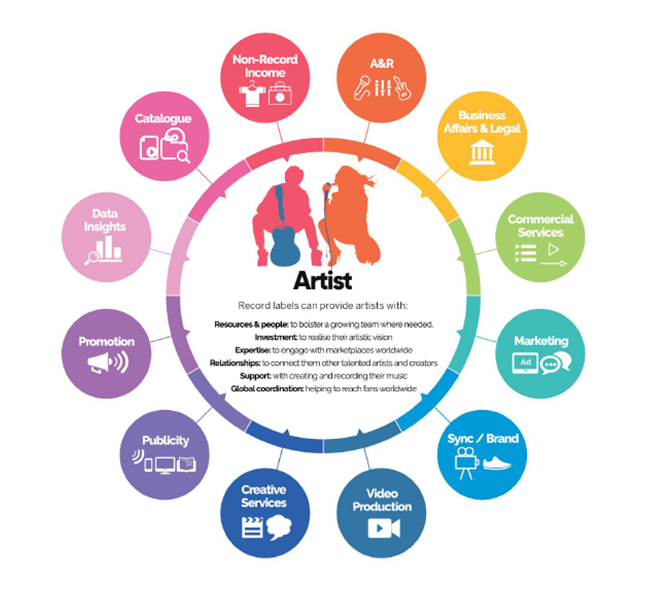
As per IFPI, in 2017, record labels invested US$4.1 billion in A&R (Artists & Repertoire) and US$1.7 billion in marketing for artists and their music for a combined total of US$5.8 billion. This equates to approximately 33.8% of global recorded music revenues invested annually into breaking, developing and supporting artists around the world. In the current music landscape, the role assumed by record labels is multi-dimensional in nature as investors, partners and collaborators with artists. The ways in which record labels can support artists is manifold- from providing adequate resources, investment and establishing connections with people from the music industry to facilitating global coordination, industry relationships and general support. The investment by labels is reflective of the continued commitment of record labels towards artists and their music. The complete report can be found here.